We are pleased to share a demonstrator from the OSCARS project (HOMEROS – Harmonising Observations from Multi-hazard Environments in Research for Open Science).
HOMEROS aims to improve multi-hazard assessment and disaster preparedness in Greece. Studying earthquakes, ground deformation, landslides and floods means working with very different kinds of data, such as seismic waveforms, GNSS observations, InSAR data and GIS layers, drawn from different sources and research infrastructures. The consortium is also distributed: Aristotle University of Thessaloniki (coordinator), the National and Kapodistrian University of Athens, the University of Patras and Lund University.
This of course raises a very practical problem: how can a distributed team share data, code and intermediate results, and build workflows that others can reproduce, when each hazard needs different software and computing capacity is not equally available at every partner?
We tackled this problem by using the EOSC EU Node as a common, institution-neutral environment. Researchers sign in with their own academic credentials, and the credit system lets us choose resources according to the task rather than relying on locally available hardware. Three services are in regular use by our group:
-
Interactive Notebooks (JupyterLab and the newly launched EOSC EU Node Binder) for workflows that can run in Python, such as our seismological analysis (described in more detail below).
-
Virtual Machines for workflows that need specialised software that cannot easily run in a notebook. For example, our geodetic workflow processes 24-hour GNSS RINEX datasets to derive Integrated Water Vapour, which provides information on atmospheric moisture and can support the monitoring of conditions that lead to heavy rainfall and flooding. VM snapshots let the configured environment be recovered and reused, which makes the workflow easier to reproduce and potentially suitable for continuous processing.
-
File Sync & Share connects the different strands, so notebooks, code, figures and results can be exchanged between partners while work is in progress.
The general pattern is the same across hazards. Data are retrieved from open repositories into a notebook or VM and processed there. The resulting products are shared within the group and then published openly, with a DOI, rich metadata and a CC BY or CC BY-SA licence, in the HOMEROS Zenodo community.
For the seismological part of the project, we developed a machine-learning-assisted earthquake analysis workflow that runs entirely in Interactive Notebooks. As a demonstrator, we applied it to the intense seismic activity on the Central Ionian Islands in early 2024. The workflow runs end to end in the notebook:
-
It retrieves waveform data from 23 seismic stations around the Central Ionian Islands from open repositories using Python libraries (e.g. ObsPy via FDSN web services).
-
P- and S-wave arrivals are picked with a deep-learning phase picker (PhaseNet, via SeisBench).
-
The picks are associated into events with pyocto and located , producing an initial earthquake catalogue.
-
Visualizations and output files for further analysis are generated in the notebook and shared within the group.
The demonstrator covered the most intense phase of the activity in March 2024. This notebook is based on the workflow that supported the publication of a HOMEROS catalogue of 7,420 earthquakes from the January–April 2024 Central Ionian Islands swarm sequence. The screenshot below shows an example output, a map of epicentres produced by the notebook, for two days starting on March 1st 2026. The stations used to retrieve data and the initial depths of the epicenters are also shown.
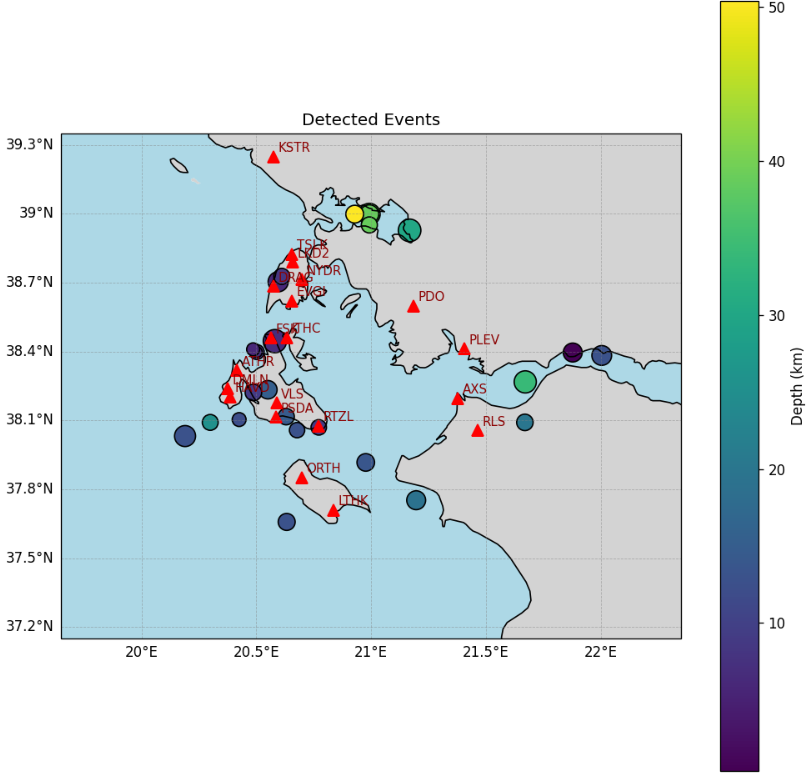
Running this in a shared notebook environment means that everyone in the group works with the same code, parameters and software versions, so results can be compared and reproduced without each person recreating the setup locally. The same environment is currently used to introduce Master’s students to machine-learning-assisted seismic analysis, without them having to install the software stack themselves.
We hope that in the future, more liberal credit allocations for Phd students and more tools available for groups within the EOSC EU NODE will allow extensive usage of the platform by early career scientists.
You can find (and try!) the interactive notebook through the EOSC EU Node binder or the HOMEROS Zenodo repository. The parameters block is already setup for the Central Ionian Islands study area, one of the most seismically active areas of Europe. Simply choose your date period and follow the steps and instructions provided within the notebook. Any feedback and notes are always appreciated!
On behalf of the HOMEROS team,
Vasilis Anagnostou, Phd candidate, Department of Geophysics, Aristotle University of Thessaloniki